Deep Learning 101 in Urdu: Neural Networks to LLMs (Codanics)
By Codanics
- Course audio
- Course audio: Urdu
- Level
- Intermediate
- Length
- 98 lessons · 42.7 hours
What you'll be able to do
- Explain the difference between machine learning and deep learning
- Build and train a multilayer perceptron in Python with TensorFlow
- Choose suitable activation functions for a network
- Apply CNN and LSTM models to image and text problems
About this course
A long Urdu-language series from Codanics that begins by comparing machine learning with deep learning and explaining what a neural network is, then moves into multilayer perceptrons and building networks in Python with TensorFlow. Along the way it covers GPU use, early-stopping callbacks, choosing layer sizes and batch size, and the main activation functions such as sigmoid, tanh, ReLU and softmax. Hands-on case studies follow, including a heart-disease dataset and a bank-churn dataset, before the course turns to convolutional networks for computer vision, recurrent networks, LSTM and sentiment analysis. The last part introduces prompt engineering, Hugging Face models, APIs and LangChain. With 98 lessons and about 43 hours, it suits learners who already know basic Python.
Before you start: Basic Python programming; Some familiarity with machine learning ideas
Syllabus
98 lessons · 42:40:07 in total
- 1Deep Learning | Deep Learning-101 Complete Course | (Day-01)1:07:45
- 2Introduction to Deep Learning5:00
- 3Machine Learning vs. Deep Learning13:58
- 4Small Data vs. Big Data for Deep Learning2:30
- 5What is a Neural Network?21:17
- 6Types of Neural Network7:07
- 7Architecture of Neural Networks4:34
- 8Single Layer vs. Multilayer Neural Network3:16
- 9Multi Layer Perceptron in Deep Learning16:25
- 10Types of Multi Layer Perceptron9:50
- 11Applications of Multi layer perceptron4:29
- 12Python Libraries for Deep Learning17:03
- 13Ten steps to create a neural Network in Python with TensorFlow10:52
- 14Build Neural Networks in Python with TensorFlow24:01
- 15GPU for Deep Learning with TensorFlow3:21
- 16Build a Multilayer Perceptron in Python with TensorFlow13:25
- 17Call Back Function for Early Stopping of epochs7:47
- 18How many neurons should be in each layer | verbose | batch size8:36
- 19Step & Sigmoid Activation functions for Artificial Neural Network54:10
- 20tanH, ReLu, Leaky Relu, Paramteric ReLu Activation Function25:53
- 21SoftMax activation functions10:30
- 22How to choose an activation function?17:29
- 23Case Studies in Python | Deep Learning-101 complete course | (Day-04)1:55:40
- 24Case Studies in Python | Deep Learning-101 complete course | (Day-05)1:15:51
- 25Case Study on UCI Heart Disease Data Project 124:51
- 26Case Study on UCI Heart Disease Data Project 234:39
- 27Case Study on UCI Heart Disease Data Project 323:11
- 28Case Study on UCI Heart Disease Data Project 410:23
- 29Competitions and Assignments for the course10:56
- 30Job Ready AI course Complete announcement3:21
Show all 98 lessons
- 31Case Study for Kaggle Competition1:04:07
- 32What is random seeding or Random State in ML?2:29
- 33Case Study on Bank Churn Dataset1:05:05
- 34Important Assignment for Kaggle Competitions0:57
- 35Convolutional Neural Network (CNN) in Python with TensorFlow | Part-115:03
- 36Convolutional Neural Network (CNN) in Python with TensorFlow | Part-235:06
- 37Convolutional Neural Network (CNN) in Python with TensorFlow | Part-336:53
- 38Convolutional Neural Network (CNN) in Python with TensorFlow | Part-426:57
- 39Convolutional Neural Network (CNN) in Python with TensorFlow | Part-51:01:29
- 40Convolutional Neural Network (CNN) in Python with TensorFlow | Part-631:10
- 41Introduction to Computer Vision30:19
- 42Computer vision in Python22:05
- 43Assignment for CNN before next class1:06
- 44Introduction | Recurrent Neural Network (Part-1)14:05
- 45All about Recurrent Neural Network (Part-2)58:42
- 46RNN in Python | Recurrent Neural Network (Part-3)17:33
- 47Introduction to Natural Language Processing (NLP) in Urdu and Hindi1:01:47
- 48Sentiment Analysis | NLP | In python46:29
- 49LSTM (Long Short Term Memory) for NLP27:05
- 50History of ANN, CNN, RNN, LSTM, GRU50:16
- 51LSTM vs. GRU types of RNN for Deep learning in NLP24:41
- 52Introduction to Time Series Data Analysis in python1:09:47
- 53Data Analysis Types for Time Series Data32:04
- 54Types of Data about Time and Time series5:09
- 55Time series analysis and plotting in python28:51
- 56Time Series Project understanding and development51:25
- 57Time Series Weather Forecasting Project (1/3)1:12:31
- 58Time series Weather forecasting project (2/3)1:21:36
- 59Time series Weather forecasting project (3/3)17:14
- 60prophet model from FB (meta) for time series analysis (1/2)1:07:57
- 61prophet model from FB (meta) for time series analysis (2/2)18:58
- 62Web-scrapping in #urdu #hindi with python (1/2)32:30
- 63Web-scrapping in #urdu #hindi with python (2/2)26:21
- 64Stock market data scrapping using python23:04
- 65ARIMA, SARIMA, SARIMAX in python complete project1:04:15
- 66Paddy Rice Disease Detection using CNN models in TensorFlow with Python54:43
- 67Underfitting of a machine learning model7:50
- 68Overfitting of a machine learning model6:38
- 69Good fit or Robus Model explained in urdu/hindi4:37
- 70How to improve a ML/DL model fitness?8:38
- 71Improving an overfit model in Machine/Deep Learning23:39
- 72Transfer Learning and pre-trained Models19:55
- 73Transfer Learning in python using TensorFlow/Keras17:05
- 74Assignment Alert for Course Students1:02
- 75Generative AI | Introduction13:08
- 76Generative AI | Key Terms33:04
- 77Generative AI | How does it Work?7:14
- 78Generative AI in 202415:01
- 79Generative AI | Will my job be taken away?5:44
- 80Pre-trained Models and Image Classification | Transfer Learning44:37
- 81Transfer learning in python with TensorFlow | A complete Project30:27
- 82Progressive growing GANs (pro-GANs) in TensorFlow51:05
- 83Assignment Alert2:33
- 84TensorBoard for Hyperparameter Tuning of Deep Learning Models38:47
- 85Introduction | Diffusion models for Generative AI (1/3)17:14
- 86Stable Diffusion model in Python with TensorFlow locally21:38
- 87SORA open AI model for Video Generation10:17
- 88Important IDs to make before next lecture3:45
- 89Introduction to prompt engineering24:36
- 90Types of Prompt engineering or prompts designing8:06
- 91Prompt designing strategies to get full potential of LLMs11:48
- 92Generate prompts from LLMs8:09
- 93LLMs and prompt engineering live demo for webapp development44:03
- 94Use pre trained models from Huggingface33:08
- 95Introduction to API (Application Programming Interface)25:30
- 96LangChain workflow for LLMs9:20
- 97Applications of LangChain for LLMs7:47
- 98LangChain + OpenAI API + HuggingFace API15:43
Questions
- How long is this course?
- It has 98 lessons and about 42.7 hours of video (42:40:07 in total). Your progress is saved lesson by lesson, so you can stop and continue on any device you sign in on, or in the same browser without signing in.
- Is this course in Urdu?
- The lessons are taught in Urdu. The teacher is Codanics; the videos play from their official YouTube channel, and Sabaq adds the lesson order, progress tracking, notes and the summary on this page.
- Who is this course for, and what should I know first?
- It is aimed at learners who already know the basics. Before you start: Basic Python programming; Some familiarity with machine learning ideas.
- Is it free, and do I need an account?
- Yes, it is free to watch and no account is needed. The videos are official uploads by the teacher on YouTube; a free DanixSoft account is optional and only syncs your progress between devices.
- What should I take after this course?
- A good next step on Sabaq is “Neural Networks: Zero to Hero (Andrej Karpathy)”. The “What to take next” list on this page shows more courses at the same or a higher level in the same topic.
What to take next

Neural Networks: Zero to Hero (Andrej Karpathy)
Andrej Karpathy
English18.6 h9 lessonsAdvanced

MIT 6.0001: Introduction to Computer Science and Programming in Python
MIT OpenCourseWare
English10 h38 lessonsIntermediate
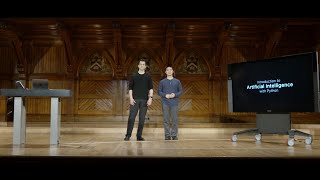
CS50's Introduction to Artificial Intelligence with Python
CS50
English12.7 h8 lessonsIntermediate
Related courses
Videos by Codanics, played from their official YouTube channel. Subscribe on YouTube
Official upload by the teacher or institution on their own channel, shown with YouTube's embedded player.
Lessons listed from the official YouTube playlist. Full playlist on YouTube
Lessons last checked Nov 2026. Course summary and lesson structure by Sabaq.
Report a problem or a rights request